
Two quotes can share a monthly price while describing different services. When you compare office cleaning companies in Indonesia, check what each price includes. One provider might restock toilet paper and wash carpets quarterly; another might barely cover the bins. The headline price may be clear while decisive details hide inside the scope.
A lower-priced offer may provide fewer productive hours or exclude supplies. A roster can also reveal whether scheduled checks are covered. Compare these details before signing, alongside notice and renewal terms.
A cleaning contract is a daily relationship played out in front of your staff and visitors, and in Jakarta the reception area often carries a brand's first impression. That makes the quality of your cleaning service a business cost rather than a housekeeping detail, and it rewards buyers who compare on substance.
This guide proposes a room-and-task brief for comparing cleaning providers. It explains proposal differences and a contract checklist. A worked cost model uses clearly labelled fictional figures. The guide draws on the team's professional perspective on proposal differences. The proposed method and model assumptions are editorial suggestions that need practitioner confirmation before publication. In this blog, we discuss each step in order, with the employment and tax questions Indonesian employers should ask before anyone signs.
1. Why Compare Office Cleaning Companies in Indonesia on Scope First?
Because the scope decides whether two prices describe the same service at all. A shared workload, timetable and supplies split can make differences between bids easier to see.
Before the detail, consider these editorial suggestions, which need practitioner confirmation:
- Build a room-and-task brief before you request prices from anyone.
- Compare productive staff-hours, coverage timing and consumables, not just the monthly fee.
- Adjust each quote for missing hours, supply caps and excluded periodic work.
- Ask employment and tax questions early, and let finance confirm the invoice treatment.
A suggested approach is to begin with a schedule of rooms and tasks rather than a price per square metre. Gather measured floor areas, occupancy and the operating calendar. Then set task frequencies for each provider to price against.
To show the proposed method, here is a hypothetical teaching brief. None of its figures come from a real site. Picture a 600 m² Jakarta office occupied by 45 people, with open-plan desks, two meeting rooms, two toilet rooms, a pantry and reception. Cleaning runs on 22 weekdays per comparison month, with seven productive cleaner-hours daily, excluding breaks.
Toilets and the pantry receive three scheduled checks spread across the working day, and meeting rooms get an afternoon reset. Daily work covers waste removal, hard floors, toilet cleaning and replenishment, pantry cleaning, and wiping of accessible desks and touchpoints. Weekly work covers accessible internal glass, ledges and detailed edge cleaning. A monthly machine scrub of hard floors and a quarterly extraction of 150 m² of carpet sit on their own lines. Exterior glass, high-access work and post-renovation cleaning stay outside the recurring brief.
The table below shows how that reads on paper. Every line, including the frequencies and workload, is a model assumption needing practitioner confirmation, not a surveyed site or a standard workload. Replace it with a client-approved survey and schedule before a real tender.
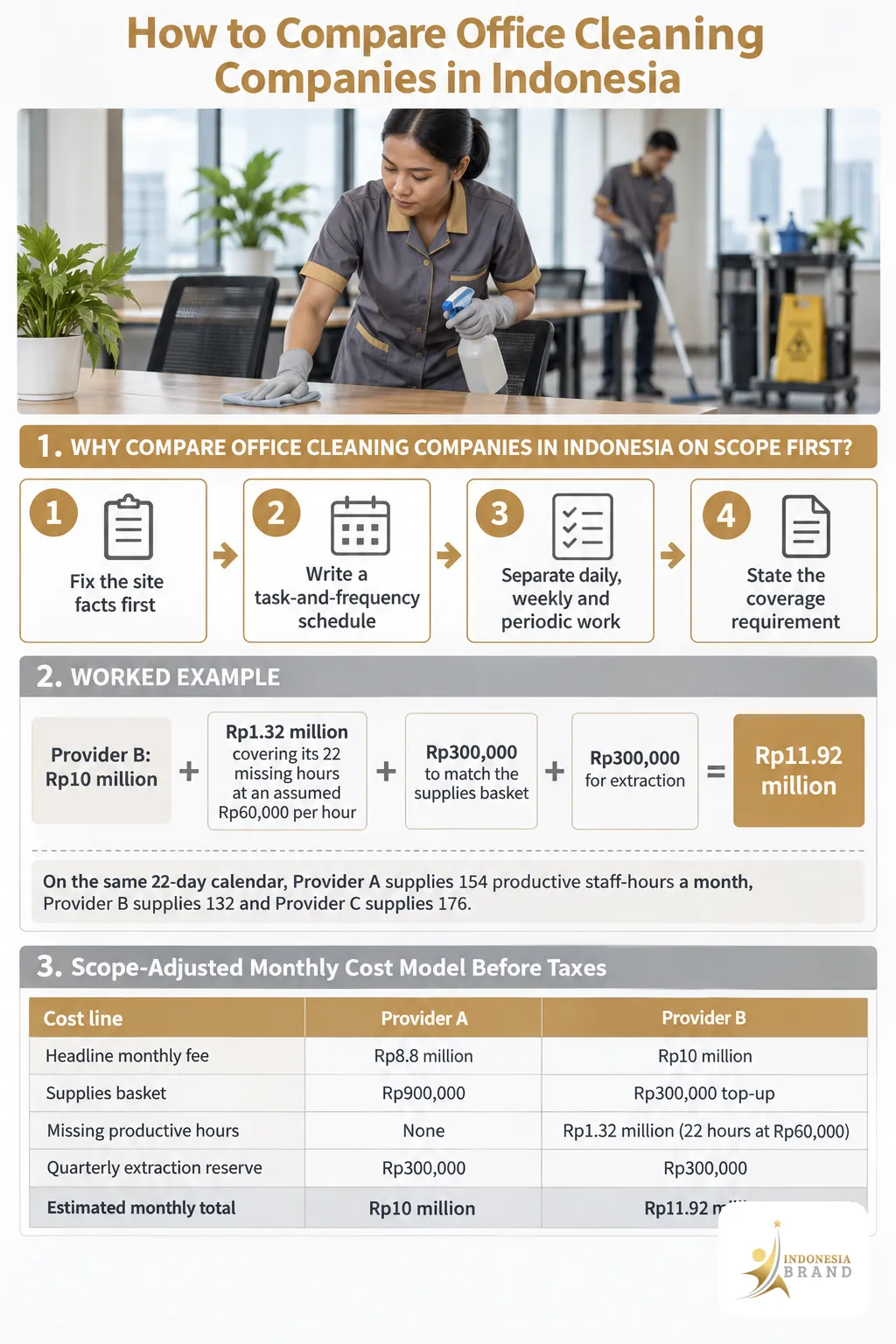
1. Fix the site facts first
Area, layout, occupancy and the operating calendar anchor every other number. Confirm whether staff must clear desks before cleaning, because moving papers and personal belongings causes avoidable disputes later.
2. Write a task-and-frequency schedule
List each task with its frequency, and require a matrix showing who performs it and when. A promise of daily toilet cleaning does not satisfy a requirement for three checks a day.
3. Separate daily, weekly and periodic work
Weekly glass and edge work, monthly machine scrubbing and quarterly carpet extraction each carry their own cost. If a proposal rolls them into a vague deep clean, ask for the scheduled dates and machine types.
4. State the coverage requirement
Specify when people must be present, not only how many hours they work. Checks distributed across the working day are a coverage requirement; cleaning that ends at noon is not, however many hours precede it.
Sample Office Cleaning Brief for a Modelled Jakarta Site
| Brief item | Modelled assumption (fictional) |
|---|---|
| Floor area and layout | 600 m²: open-plan desks, two meeting rooms, two toilet rooms, a pantry and reception |
| Occupancy | 45 people |
| Service calendar | 22 weekdays per comparison month |
| Productive cleaner-hours | Seven per day, excluding breaks |
| Daily tasks | Waste removal, hard floors, toilet cleaning and replenishment, pantry cleaning, desk and touchpoint wiping |
| Scheduled checks | Three toilet and pantry checks daily; afternoon meeting-room reset |
| Weekly tasks | Accessible internal glass, ledges and detailed edge cleaning |
| Periodic work | Monthly machine scrub of hard floors; quarterly extraction of 150 m² of carpet |
| Outside the recurring brief | Exterior glass, high-access work, post-renovation cleaning |
2. Which Details Separate Comparable Proposals?
Staffing hours, coverage timing, consumables and replacement terms: those are the lines that decide what a monthly fee actually buys.
When comparing an office cleaning service proposal in Indonesia, start with the staffing plan before the price. Two offers can share the same calendar yet hide very different commitments. To make the pattern visible, we model three fictional providers against the hypothetical 600 m² brief above.
A disclosure before any numbers: all three profiles are fictional teaching assumptions that need practitioner confirmation. They do not reproduce supplier documents or describe real Indonesian companies. The prices are not market quotations. Before using real provider material, record the selection basis, relevant commercial relationships, proposal and survey dates, sources and permission status. Do not claim independence or permission without confirmation.
- Provider A is labour-led: one cleaner delivering seven productive hours daily, routine equipment included, consumables funded by the client, no quarterly carpet extraction, at a modelled Rp8.8 million per month.
- Provider B bundles supplies: one cleaner at six productive hours daily, supplies included to a Rp600,000 monthly cap, carpet extraction excluded, at Rp10 million.
- Provider C runs a split shift: two cleaners at four productive hours each, routine supplies, equipment, the monthly scrub and quarterly extraction included, at Rp11.2 million.
All three modelled fees sit before any applicable invoice taxes.
1. Productive staff-hours versus site coverage
Hours measure work done; coverage measures whether people are present when the brief demands them. On the same 22-day calendar, Provider A supplies 154 productive staff-hours a month, Provider B supplies 132 and Provider C supplies 176. Provider B is 22 productive staff-hours short of the model brief; that figure alone does not establish when any coverage gap occurs. Provider C supplies more hours, but its split-shift timetable must still cover the midday toilet checks. Two people present together for four hours do not automatically provide eight hours of coverage.
2. Who supplies which consumables
Split the list in two: cleaning chemicals and refuse bags that the provider uses, and occupant items such as toilet tissue, hand soap and paper towels that staff consume. In the model, Provider A leaves both to the client, Provider B bundles both under its Rp600,000 cap, and Provider C includes both at the agreed occupancy against a written stock list. An office that markets sustainability can also extend its eco-friendly branding to the cleaning cupboard by specifying labelled chemicals.
3. Equipment replacement and relief staffing
All three modelled profiles include ordinary tools and the monthly floor-scrubbing equipment, but their replacement terms differ. The fictional replacement terms are:
- Provider A offers a loan machine on the next working day.
- Provider B repairs or replaces within three working days, without a guaranteed loan unit.
- Provider C provides a substitute within one working day. Also ask whether absence cover preserves the contracted productive hours, or merely promises a replacement eventually.
Three Modelled Office Cleaning Offers Compared
| Item | Provider A (labour-led) | Provider B (bundled) | Provider C (split shift) |
|---|---|---|---|
| Headline monthly fee | Rp8.8 million | Rp10 million | Rp11.2 million |
| Cleaners per day | One | One | Two, four productive hours each |
| Productive staff-hours per month | 154 | 132 | 176 |
| Cleaning chemicals and refuse bags | Client-funded | Included to a Rp600,000 cap | Included, per stock list |
| Occupant consumables | Client-funded | Included under the same cap | Included at agreed occupancy |
| Monthly floor scrub | Included | Included | Included |
| Quarterly carpet extraction | Excluded | Excluded | Included |
| Machine replacement terms | Loan unit next working day | Repair or replace in three working days | Substitute within one working day |
3. What Belongs on an Office Cleaning Contract Checklist in Indonesia?
The exclusions, separately priced services and commercial terms that decide what the monthly fee really buys.
The first fine print to examine is the definition of included. The modelled offers differ:
- Provider A vacuums carpets but excludes extraction.
- Provider B covers accessible internal glass, but excludes exterior glass and work requiring access equipment.
- Provider C includes quarterly extraction but excludes stain restoration and moving heavy furniture. All three exclude post-renovation cleaning, pest control and specialist hazardous-waste handling.
Those exclusions are reasonable when stated openly. The trouble is a headline promising complete office cleaning while the schedule quietly narrows it. Relocation raises the same trap: a moving company in Jakarta will carry your desks to a new floor, but move-day and post-move cleaning usually sit outside a recurring contract.
Ask each provider to confirm these points in writing:
- Weekend or public-holiday attendance, and how it is priced
- Event cleaning and one-off deep cleans
- Transport and machine mobilisation charges
- Initial catch-up cleaning on handover
- Waste movement beyond the building's designated collection point
- Replacement tools and consumables above any cap
- Cancellation notice, automatic renewal and price-adjustment triggers
- The remedy when attendance is missed
Customer reviews and references still matter, but a clause outlives a sales conversation. Our team publishes actual wording only after reading the proposal and the contract together, because the two documents do not always agree.
4. How Do You Compare Office Cleaning Costs Fairly?
By adjusting every quote to the same scope, adding missing hours, supplies and periodic work, before dividing the price by the hours delivered.
A comparison sheet should hold the signed scope, measured areas, task frequencies, coverage timetable, productive staff-hours, relief arrangements, consumables basket, equipment list, periodic-work schedule, exclusions and the invoice tax treatment. Office cleaning costs in Jakarta then become comparable line by line rather than headline by headline.
The worked model below adjusts the three fictional profiles toward the same brief; the totals do not establish equivalent service or a winner. Every input is an assumption: the Rp60,000 hourly add-on rate, the Rp900,000 supplies basket and the Rp300,000 quarterly reserve are invented for teaching, not taken from supplier quotes. All totals sit before any applicable taxes.
- Provider A: Rp8.8 million, plus Rp900,000 for the supplies basket and a Rp300,000 monthly reserve for quarterly extraction, reaching Rp10 million.
- Provider B: Rp10 million, plus Rp1.32 million covering its 22 missing hours at an assumed Rp60,000 per hour, Rp300,000 to match the supplies basket, and Rp300,000 for extraction, reaching Rp11.92 million.
- Provider C: Rp11.2 million, with the basket and periodic work already included.
Dividing the modelled price by productive hours exposes what the headline hides. Provider A works out near Rp57,143 per productive hour as quoted, or about Rp64,935 once the scope is adjusted. Those are diagnostic figures for the model, not a cleaner's wage and not a market rate, because a provider's selling price and an individual cleaner's earnings are different things. Our team would not deduct anything from Provider C for its extra 22 hours unless Provider C actually requotes.
Provider B's supplies top-up assumes its full cap covers the modelled basket. Obtain a written quote for the extra hours and confirm that the roster covers the required checks. The model establishes neither condition, and its assumptions need practitioner confirmation.
Scope-Adjusted Monthly Cost Model Before Taxes
| Cost line | Provider A | Provider B | Provider C |
|---|---|---|---|
| Headline monthly fee | Rp8.8 million | Rp10 million | Rp11.2 million |
| Supplies basket | Rp900,000 | Rp300,000 top-up | Included |
| Missing productive hours | None | Rp1.32 million (22 hours at Rp60,000) | None (22 extra hours, not deducted) |
| Quarterly extraction reserve | Rp300,000 | Rp300,000 | Included |
| Estimated monthly total | Rp10 million | Rp11.92 million | Rp11.2 million |
| Cost per productive hour | About Rp57,143 headline; Rp64,935 adjusted | Meaningful only after a roster fix | About Rp63,636 headline |
5. Which Compliance Questions Protect Your Business?
Employment obligations, worker registration and invoice tax treatment, all checked against each provider's own documents rather than assumed from a price.
A low service-hour price does not demonstrate that employment obligations have been met or that attendance will be reliable. Ask three compliance questions before signing. Kemnaker's regulation covers working time, rest periods and overtime. The tax authority lists cleaning services among those relevant to PPh Article 23 withholding.
1. Wages, working time and THR
Ask which wage requirements apply to the employment arrangement and location, and check the current rules on the Ministry of Manpower's legal register. Employers also owe a religious-holiday allowance (THR) to eligible workers, with eligibility and amounts set by the applicable rules and each worker's circumstances. Note that our model's seven productive hours are a service requirement, never an instruction to skip breaks.
2. BPJS registration for cleaning staff
Employers must register workers for the applicable BPJS Ketenagakerjaan employment social-security programmes under the participation rules. Ask which programmes cover the people working on your site, and request evidence of the provider's actual arrangements, because a cheap service-hour price is not evidence that these obligations have been costed.
3. VAT and withholding on the invoice
The tax treatment of a cleaning-service invoice must be checked for the particular transaction rather than assumed. Check the tax authority's VAT invoicing rules as well. Have finance confirm the VAT and withholding position for each supplier, since the model's totals are all before applicable taxes.
6. How Do You Inspect, Score and Escalate Cleaning Problems?
With a written inspection checklist, agreed scores and response times, and escalation steps that follow the contract rather than a temper.
A proposal can form an enforceable agreement when accepted and the applicable legal requirements are met; measurable service standards make performance easier to assess. The sample checklist below is an original draft, not a provider's QA document. Its thresholds and response times are suggested contract terms, not provider promises, industry standards or statutory deadlines. The checklist and targets need practitioner confirmation and agreement for the actual contract. Each checkpoint scores 0 for failed, 1 for partly complete and 2 for complete, with 18 out of 20 as a suggested routine acceptance target. A serious safety defect or an unusable toilet fails the inspection regardless of the total.
Record the location, inspection time, task due time, owner and correction deadline. Photographs should avoid people, screens and confidential papers.
1. Set response times in the contract
Suggested service levels:
- Report an urgent slip or chemical hazard immediately and isolate the area.
- Request acknowledgement within 15 minutes during staffed hours.
- Request make-safe action within 30 minutes during staffed hours.
- Expect routine defects to be corrected within two working hours. Weekly supervisor checks and a monthly client review keep the record current.
2. Escalate by pattern, not temper
The draft suggests escalating a repeat defect to the supervisor and using repeated defects to prompt a written corrective-action plan and joint inspection, subject to practitioner confirmation and agreement. Our suggested intervention thresholds, two uncovered shifts in a month or two consecutive monthly inspections below standard, are hypothetical terms to negotiate, not rights that exist automatically.
3. Know when a provider must change
In a hypothetical coverage failure, the cheapest offer leaves afternoon toilet checks uncovered because its cleaner finishes at noon. More chemicals do not fix a coverage failure; a revised roster may address it. Seek immediate suspension of affected work for a serious safety risk. Substantiated theft, falsified records or an unresolved material compliance failure may warrant considering replacement, with contractual advice where needed.
Crossing a checklist threshold is not by itself a right to terminate, so read the contract's breach, notice, cure and termination provisions first. Plan access-card returns, key reconciliation, supply ownership, equipment removal and a handover to reduce disruption. And if a past supplier taught you a hard lesson, share your story so other founders can compare more wisely.
Sample Ten-Point Cleaning Inspection Checklist
| Checkpoint | What a complete pass looks like |
|---|---|
| Toilet fixtures | Clean, dry and working |
| Toilet floors | Clean and dry |
| Tissue and soap | Stocked at every scheduled check |
| Pantry surfaces | Clean, with sinks left clear |
| Waste removal | Taken to the building's collection point |
| Desk-area floors | Clean, no litter or debris |
| Meeting-room readiness | Reset and ready for afternoon use |
| Entrance and glass | Smear-free and presentable |
| Periodic work | Completed on the scheduled date |
| Chemical storage and walkways | Secure storage; dry, unobstructed walkways |
Conclusion
Comparing cleaning proposals is less about finding the lowest number and more about forcing every provider to price the same workload. Build the room-and-task brief first, convert it into frequencies, coverage hours and a supplies split, then adjust each quote for missing hours, caps and excluded periodic work before judging the fee.
Keep the contract checklist beside every proposal, and put wages, working time, THR, BPJS registration and invoice tax questions to each provider in writing. The figures throughout this guide are fictional teaching assumptions, so replace them with surveyed areas, written quotations and your finance team's confirmation.
Follow this method and you can compare office cleaning companies in Indonesia on substance rather than discounts. Indonesia Brand supports local businesses with guides and a business and events directory. Explore our resources or contact us to discuss your brand.
Ready to Shortlist Your Cleaning Partner?
Build a scope-first brief, avoid hidden exclusions and compare providers against your budget and required service. Talk to Indonesia Brand about getting your business seen by the right people.
Frequently Asked Questions
Cost depends on the site's scope, staffing, supplies and periodic work. This article's fictional teaching model uses assumed prices, not real provider quotations or market rates. Request itemised written quotations for your own site.
A signed scope, measured areas, a task-and-frequency matrix, the coverage timetable, productive staff-hours, relief arrangements, the consumables split, an equipment list, the periodic-work schedule, exclusions and the invoice tax treatment. That is the level of detail that lets two proposals be compared line by line.
Adjust every quote to the same scope first: add the cost of missing productive hours, supplies above any cap and excluded periodic work, then, if useful, divide the adjusted price by the quoted productive hours as a diagnostic. Confirm the roster separately; the calculation does not establish equivalent coverage or a winner. Confirm separately who supplies cleaning chemicals versus occupant consumables such as tissue and soap.
Ask for evidence covering wages, working time, overtime and THR under the applicable Kemnaker regulations, worker registration with the relevant BPJS Ketenagakerjaan programmes, and confirmation of the VAT and withholding treatment of each invoice with your finance team.
When a pattern emerges, such as repeated uncovered shifts or inspections below the agreed standard, request a written corrective-action plan with a fixed review date. Suspend affected work immediately for a serious safety risk, and check the contract's notice, cure and termination provisions, with legal advice where needed, before acting.

Indonesia Brand
Author
We are dedicated to promoting and celebrating business brands in Indonesia. We share the inspiring success stories of homegrown brands, highlighting their achievements and growth.

