
An editor reviewing a brand submission applies a simple logic: every factual claim is only as strong as the record behind it.
Many Indonesian small and medium enterprises (SMEs) arrive with a polished story, photographs and a pitch, but without proof. Editors compiling directory profiles, success stories and curated guides then face claims that cannot be traced, from broad superlatives to undated growth figures. The strongest submissions do something different: they pair each claim with a checkable source before anyone asks.
This matters because a verified claim builds reader trust, while an unsupported one weakens the entire profile. In this blog, we discuss how to build an evidence pack for editors Indonesia. It covers legal identity, BPOM, halal and SNI verification, milestones, growth figures, confidentiality and consent.
1. What Goes into an Evidence Pack for Editors Indonesia?
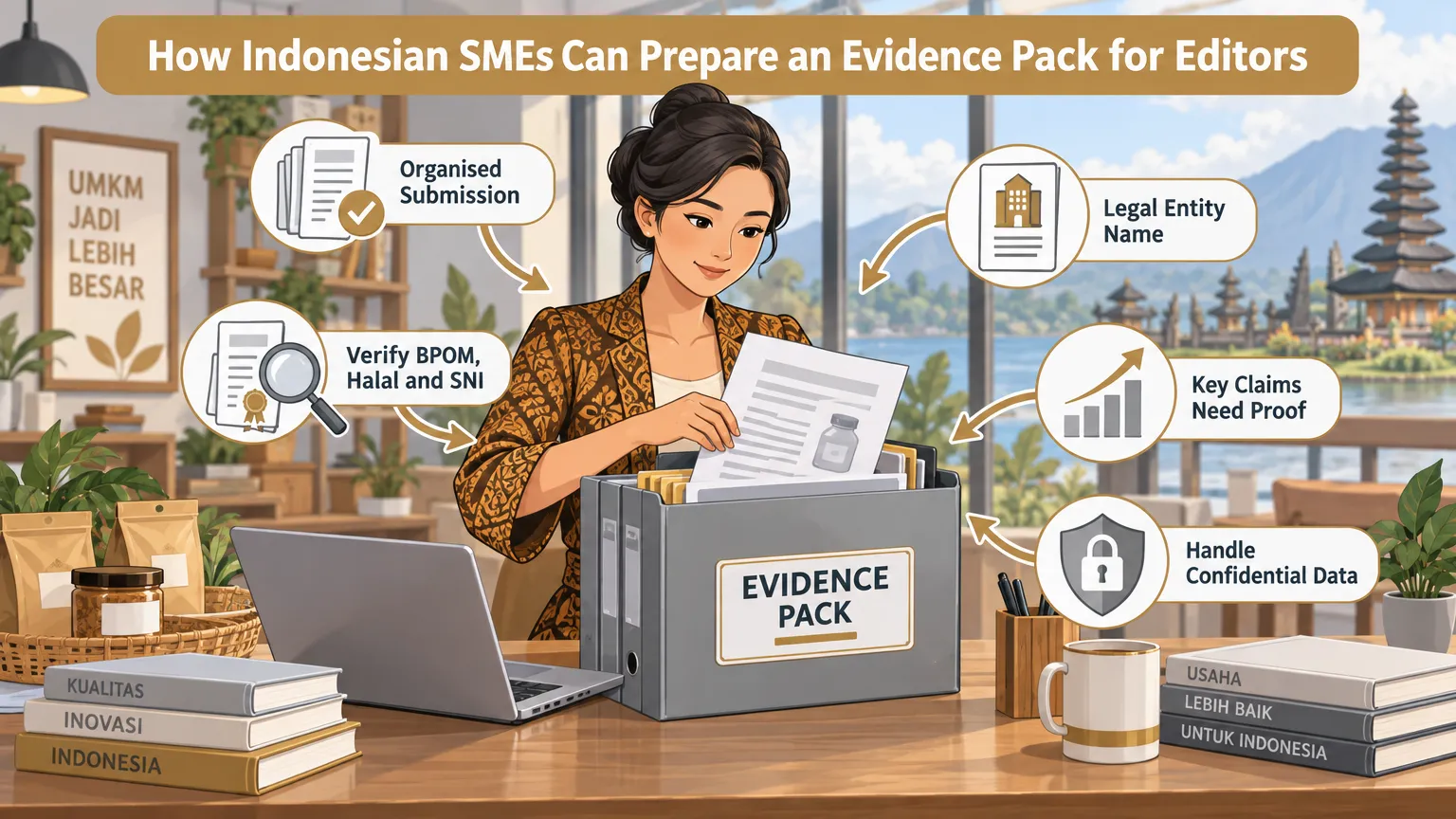
An evidence pack is a single organised submission that pairs every factual claim with the record that supports it. Instead of a folder of unexplained files, the brand submits a claim-by-claim map. The team at Indonesia Brand recommends this structure as a suggested submission format, not as a mandatory house form or confirmed checklist.
Official registries are now checkable online, so editors can move quickly when the right records are supplied. Claims resting on public registries are straightforward to accept, while performance claims need equal discipline. Many Indonesian brands delegate this preparation to outside help, so understanding how to choose a PR agency in Jakarta and typical media relations retainer costs pays off before signing anything.
A brand featured in curated Best in Indonesia guides should be presented to readers as checked. The guides cover everything from movers to home cleaning services in Jakarta. That expectation begins with the submission, not with the editing.
Key takeaways include:
- Pair every factual claim with one named source before submission.
- Check regulated credentials against the issuing authority, not a marketplace page.
- Date every milestone and anchor every growth figure to a baseline.
- Narrow any superlative you cannot fully support.
- Collect publication, privacy and consent confirmations separately from the story.
1. Map each claim to one source
Each claim gets one line: the sentence the brand wants published, the geography and period it covers, and the document behind it. A claim without a source is a draft, not a submission.
2. Record the exact public wording
State the sentence the evidence actually supports. If a halal certificate covers three products, the wording should name those products. Writing a whole-brand claim when the certificate covers a single line overstates the evidence and invites a rewrite.
3. Note permission and limitations
For each source, record who owns it, whether it may be published, and any restriction such as scope, expiry or confidentiality.
2. How Do You Verify BPOM, Halal and SNI Claims?
Each credential is verified by matching its registration or certificate number, holder and covered product against the issuing authority's own database. Regulated credentials are the easiest claims to check because each one sits in an official record. A useful first question is the number: which authorisation, held by whom, covering which product.
In practice, useful submissions carry the number from the start. Records that include the registration or certificate number, holder, covered products, issue date, status and expiry pass credential checks without a second round. Submissions that omit the number may require further checks, because BPOM and BPJPH also allow searches by product, brand or business operator.
1. Check BPOM claims against the official database
BPOM's public product database, the Cek Produk service, allows searches by product name, brand, registration number and registrant. A submission should list the exact product, brand and authorisation number so the entry can be matched to the right registrant and current status. This applies only to products within BPOM's relevant registration system, and matching the entry to the particular product and status remains part of the check.
2. Verify halal claims through BPJPH
BPJPH's official halal search covers product name, business operator and certificate number, and its results show listed products, producers, certificate numbers and dates. The pack should name the certificate number, the holder and the covered products. A halal claim must stay within the actual holder, products and status. A certificate does not automatically cover an entire brand, all facilities or every variant.
3. Keep SNI claims inside the certificate scope
BSN, the national standards agency, treats product, process and service certification as conformity-assessment activities under its standards catalogue. An SNI claim should identify the certificate, the certified object or scope, and the issuing certification body (LSPro). It should not expand into a blanket statement that the whole brand is certified. Check the applicable scheme and validity for each individual claim.
Credential Verification Routes for Indonesian SMEs
| Claim | What to record | Official check |
|---|---|---|
| BPOM registered or approved | Exact product, brand, registration number, registrant and status | BPOM public product database (Cek Produk) |
| Halal certified | Certificate number, certificate holder, covered products and status | BPJPH halal search and certificate verifier |
| SNI certified | Certificate number, scope, certified product or process, issuing body and validity | Certification body (LSPro) and BSN records |
| Business registration | Legal entity name, entity type and NIB | OSS-issued NIB, with AHU records where available |
3. What Legal Identity Should a Business Profile Submission Include?
A business profile submission should carry the legal entity name, entity type, Nomor Induk Berusaha (NIB) and evidence for every claimed location. Editors look at identity before anything else. A weakness often seen is a strong brand story attached to thin legal evidence — a polished pitch, a social-media handle and no NIB or AHU record.
Where legal standing matters, the submission should rely on official records rather than social presence. The recommendation about editorial sufficiency is the team's judgement; the status of the NIB itself comes from the authority.
1. Start with the NIB and legal entity details
The Online Single Submission (OSS) system describes the NIB as the official identity for starting or conducting business in Indonesia. A submission that depends on legal standing should include the entity name, entity type, NIB, year established and founder details as recorded officially. An NIB is an official identity, but it does not prove every statement about a business. Social-media or marketplace profiles are supporting context, not incorporation evidence.
2. Cross-check corporate records where available
The AHU legal-administration system provides company-data search and profile-download routes that can confirm relevant corporate information. Use this only where the entity type and available AHU record make it appropriate, since not every Indonesian SME holds the same record.
3. Evidence each location you claim
The operating address and claimed branches should match a primary document. This could be a lease or recent utility bill with private details redacted. They should also match a current public source. A location is supportable when the two agree, or when the editor can confirm it with the named contact. The same consistency matters after any change of address registered through the OSS system for company registration.
SME Media Submission Checklist: Claim Types and Accepted Proof
| Claim type | Accepted proof | Common pitfall |
|---|---|---|
| Milestone, such as founding or launch | Dated incorporation record, first commercial invoice, launch announcement or archived page | Using the idea date or mixing incorporation with first sale |
| Growth percentage | Named metric, start and end values, stated periods and consistent accounting treatment | Quoting a percentage with no baseline or dates |
| Customer outcome | Dated report, dashboard export, invoice-backed summary or customer confirmation | Mixing followers, downloads and paying customers |
| Superlative, such as number one or the first | Independent ranking or dated public record defining category, comparator and geography | Broad claim with no market definition |
| Testimonial | Written approval of the final wording from the quoted person | A quote that cannot be traced to a consenting customer |
4. Which Business Claims Need the Tightest Proof?
Milestones, growth figures, customer outcomes and superlatives need the tightest proof because their wording drifts furthest from the evidence. In practice, these claims fail on three checkable points: no baseline, no comparison dates, and no definition of what was counted.
Each of these claim types can be rescued by narrowing. A precise, dated, defined claim is weaker-sounding but publishable; a broad one with no support is not.
1. Date every milestone precisely
State which date a milestone means: incorporation, first commercial sale or public launch. Support it with a contemporaneous record such as a dated invoice, contract, launch announcement, archived page or event record. Prefer the documented first sale over the founding idea.
2. Anchor every growth figure
This is guidance, not an accounting rule or audited-data standard. A usable growth claim names the metric, start and end values, and comparison periods. It also states the accounting treatment, including whether figures are gross, net, booked or collected. If the baseline is missing, narrow, attribute or omit the claim.
Consistent bookkeeping makes this far easier: keep dated records of invoices, receipts and adjustments so every baseline figure can be matched to its source documents before submission.
3. Define what a customer outcome counts
This is a practical evidencing recommendation, not a stated Indonesia Brand threshold. Specify what is counted: unique buyers, accounts, transactions or users. State the period, whether the figure is cumulative, and how cancellations and refunds are treated. A dated report, a dashboard export, an invoice-backed summary or a customer who can confirm the wording supports the claim.
4. Narrow superlatives and availability claims
These examples are wording patterns to test, not a list of rejection reasons. Claims such as number one, the first or available nationwide need a defined category, comparator, geography, period and meaning. Shipments to selected provinces, stated plainly, are weaker-sounding but publishable. Verified facts presented well, supported by the right digital branding tools for Indonesian SMEs, usually work better than inflated wording.
Suggested Consent Checklist for Editorial Submissions
| Consent item | Suggested status |
|---|---|
| Authority to represent the business | Blocking |
| Permission to publish the submitted factual information | Blocking |
| Authorisation to use the logo | Blocking |
| Copyright ownership or valid licence for each photograph | Blocking |
| Permission from identifiable people shown where required | Blocking |
| Testimonial approval from the quoted person or authorised representative | Blocking |
| Privacy notice and lawful basis under the Personal Data Protection Law | Blocking |
| Identification of confidential or third-party-restricted material | Blocking |
| Social promotion and newsletter reuse | Optional |
| Translation, cropping and future updates | Optional |
5. How Should You Handle Confidential Data and Consent?
Confidential material, estimates and personal data need explicit labels, inspectable substitutes and separate consents. The handling matters as much as the content, because an editor cannot use a figure that cannot be examined.
This section is proposed handling guidance based on the team's editorial judgement. Each publisher's non-disclosure process, retention rules and acceptable substitutes should be confirmed before relying on them.
1. Label confidential and estimated evidence
Mark restricted items as confidential and for verification only, name who may inspect them, and state the wording that may be published. Label estimates as estimates, with the preparer, method, assumptions and period. A precise figure should not be described as independently verified when the underlying support cannot be inspected.
2. Substitute inspectable evidence where possible
Useful substitutes can include a redacted contract or invoice extract, an aggregated dashboard export, or a schedule of totals. They can also include a permitted third-party statement or an on-screen inspection followed by a dated note. Exact revenue, valuation or market-share figures that nobody can inspect are usually omitted, with the direction of growth attributed instead.
3. Collect consents separately
A submission should separately confirm authority to represent the business, rights to use logos and photographs, approval for quotations or testimonials, and confidentiality restrictions. Wider reuse permissions, such as social promotion, translation or future updates, should be optional and separately selected. Indonesia's Personal Data Protection Law (Law No. 27 of 2022) regulates how personal data is processed, so the submission should minimise unnecessary personal data and use an approved privacy process. These items form a suggested checklist subject to legal review, and sensitive pre-submission questions can go through the contact page.
Conclusion
An editorial evidence pack turns a brand story into a checkable record. The discipline is consistent. Start with legal identity. Verify regulated credentials against the issuing authority. Anchor every milestone, growth figure and customer claim to dated evidence. Where support is missing, narrow the wording rather than stretch it.
Consents, confidentiality labels and privacy handling complete the pack, so an editor can move quickly from claim to source. The team at Indonesia Brand applies this approach across directory profiles, success stories and curated guides for local brands.
Businesses preparing an Indonesian business profile submission can get help shaping the claim map and gathering the right proof. A small amount of preparation before submission saves rounds of clarification afterwards and makes the editor's review faster and easier.
Get Your Brand Submission Ready
Indonesia Brand helps local SMEs turn verified facts into publishable profiles, success stories and curated-guide features.
Frequently Asked Questions
It is a single organised submission that pairs each factual claim with the record that supports it, including the exact public wording, geography, period, source, source owner and publication permission.
No. The OSS system describes the NIB as the official identity for starting or conducting business in Indonesia. Social profiles support the brand story, but they are not incorporation evidence, and an NIB alone does not prove every claim.
Record the exact registration or certificate number, holder and covered products. Check BPOM entries in its public product database, halal claims through BPJPH's search, and SNI claims against the certificate scope and issuing certification body.
Label the material as confidential and for verification only, then offer an inspectable substitute such as a redacted extract, an aggregate or a permitted third-party statement. A figure nobody can inspect should not be described as independently verified.
Yes. Obtain written approval of the final wording from the quoted person or an authorised customer representative. Personal data must also be handled in line with Indonesia's Personal Data Protection Law, and wider reuse permissions should be optional and separate.

Indonesia Brand
Author
We are dedicated to promoting and celebrating business brands in Indonesia. We share the inspiring success stories of homegrown brands, highlighting their achievements and growth.


