
A business profile can collect many views and website clicks while producing no paying customer. To measure a directory listing's ROI, ask whether the placement produced qualified leads that became revenue.
Many Indonesian customers move straight to WhatsApp, a phone call or a branded Google search after seeing a feature. Those journeys may carry no tracking tag. An SME in Jakarta may appear in a curated guide, success story and directory profile. It may still lack a reliable way to identify which placement earned its fee.
For micro and small enterprises, marketing budgets are thin, so every rupiah of spend must justify itself. Treating page views as success can renew the wrong placement. It can also cause an SME to drop the right one. A simple, consistent measurement habit can avoid both errors. The guidance reflects the Indonesia Brand editorial team's professional judgement.
In this blog, we discuss how to separate qualified leads from vanity traffic and track WhatsApp leads from marketing placements. We also explain how to turn a placement's cost into a clear commercial verdict.
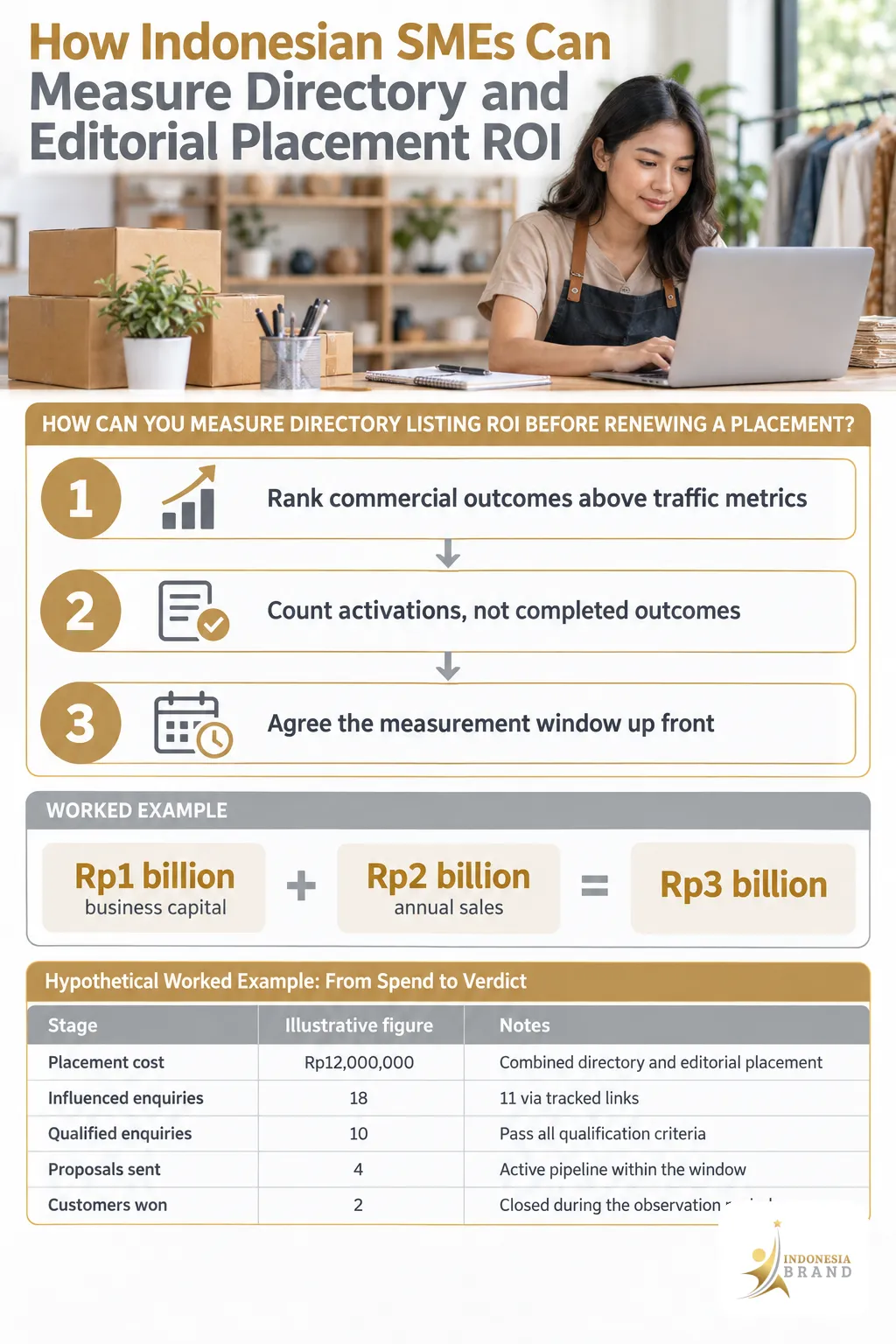
How Can You Measure Directory Listing ROI Before Renewing a Placement?
Key takeaways:
- Judge a placement on qualified enquiries and margin contribution, not page views
- Count every tracked click as an activation, never as a completed conversation or sale
- Capture the source of WhatsApp, phone and walk-in enquiries at first human contact
- Agree a measurement window up front, then decide: renew, improve or stop
The short answer is to rank commercial outcomes above traffic metrics. In the team's experience advising featured businesses, the first step is an outcome hierarchy: qualified enquiries, then proposals, then sales and margin contribution. Page views, scroll depth and social shares are supporting signals only. This is a recommended decision framework, not a documented performance standard, and each SME should set its own weightings.
Budget discipline explains why the hierarchy matters. The Ministry of Cooperatives and SMEs applies Government Regulation Number 7 of 2021. Under that regulation, a micro enterprise holds business capital of up to Rp1 billion, excluding land and buildings used for the business, or annual sales of up to Rp2 billion. Small enterprises sit above those thresholds. For most featured businesses, a placement fee is a material spend that must earn its place.
Three habits keep the measurement honest. They apply whether the placement sits in a directory, a guide or an editorial feature.
1. Rank commercial outcomes above traffic metrics
A placement that generates views but no qualified enquiries has bought attention, not business. Judge it on enquiries that fit the target market, proposals issued and margin earned, in that order.
2. Count activations, not completed outcomes
A website, WhatsApp, phone, email, map or registration link registers a click when the visitor taps it. It does not prove a message was sent, a call connected or a purchase happened. Label events precisely and report clicks as clicks.
3. Agree the measurement window up front
Decide before the placement goes live how long it will run before judgement. A practical starting point for a short-cycle business-to-business placement is 90 days. Add a further 30 days for open leads to mature. This is an example timing framework, not a verified standard. The right window depends on the SME's sales cycle.
What Makes a Lead Qualified When It Arrives from a Directory or Editorial Feature?
A qualified lead is an enquiry that passes the SME's own definition of a realistic buyer. The criteria below are illustrative examples. Each business must set and own its own screen.
Qualification is a filter the SME applies at first response, not a property the placement delivers. The team's suggested screen for a business-to-business SME covers five checks, summarised in the table below.
Just as important is recording what fails the screen. A WhatsApp greeting with no question, a job application, a vendor pitch, spam or a request outside the service area does not qualify. Logging a disqualification reason shows whether a placement attracts the wrong audience or simply attracts nobody. Those are two very different problems with two very different fixes.
Qualification Screen for Directory and Editorial Leads
| Criterion | Question to ask | Qualifies when |
|---|---|---|
| Customer and service-area fit | Is the enquirer in our service area and target market? | Location and business type match the SME's offer |
| Genuine need | What problem are they trying to solve? | A specific, real requirement for the product or service |
| Buying process | Who decides, and how is the purchase approved? | Access to the decision-maker or a clear purchase path |
| Budget plausibility | Does the stated budget match our pricing? | The budget is realistic for the scope requested |
| Timeframe | When do they plan to act? | Intent to buy within the SME's normal sales cycle |
Which Actions Can Each Placement Format Actually Register?
Each format registers clicks on the actions its page template exposes. This is a measurement principle to apply, not a statement of any live platform's current tracking.
Across a media portal's formats, the registered actions differ because the templates differ. A business directory profile usually exposes the widest action set; a guide entry or a press release exposes fewer. What unites them is the counting rule: every registered action is an event, not a completed business outcome.
Before relying on any specific event name or call-to-action module, featured businesses should confirm the live event taxonomy. The platform's analytics team can confirm it. The following section-level breakdown reflects how the formats are typically built, not a verified inventory of current page templates.
1. Directory profiles expose the widest action set
A profile normally carries website, WhatsApp, tap-to-call, email or enquiry form, map and social-profile links. Each is registered as a click when tapped — none proves a completed conversation.
2. Guide entries and editorial stories expose curated links
A guide entry typically offers a click to the business website or its portal profile. WhatsApp or enquiry buttons appear only where the entry template includes them. A story adds inline website links, related articles and share actions.
3. External registrations count only the click
If a registration form sits on an external site, the platform registers only the registration-link click. A completed registration registers only when the form is hosted on the same platform. It also registers if the organiser returns a conversion signal.
Placement Formats and the Actions They Typically Register
| Format | Actions usually exposed | What a click does not prove |
|---|---|---|
| Directory profile | Website, WhatsApp, tap-to-call, email or enquiry form, map, social links | That a message was sent or a call connected |
| Best in Indonesia guide entry | Website or profile click; WhatsApp only where the entry template includes it | That the visit turned into an enquiry |
| Editorial success story | Inline website links, profile link, related articles, share actions | That the reader contacted the business |
| Press release | Issuer website, contact email or phone, downloadable media, profile link | That a download led to coverage or a sale |
| Event listing | Registration or ticketing link, organiser website, WhatsApp or phone, map, calendar | That a registration completed on an external site |
How Do You Track WhatsApp Leads from Marketing Placements?
Tag every link consistently, and ask one neutral source question at first human contact. Web analytics alone rarely connects a WhatsApp tap to the conversation that follows.
A UTM on a wa.me link may not reliably identify the resulting conversation inside WhatsApp. Phone or offline discovery can escape web analytics entirely. The practical fix combines consistent tagging with source collection at first response. Then a shared log survives handovers between reception, the WhatsApp administrator and sales.
A simple stack is enough. The site's guide to digital branding tools for Indonesian SMEs covers the basics. Discipline matters more than software. The team's suggested approach has three parts. Every business should adapt them to its own CRM, consent process and sales workflow.
1. Use one consistent UTM convention
Keep the source and medium stable. Put the format and placement in the remaining fields:
- utm_source=indonesiabrand.co.id
- utm_medium=referral
- utm_campaign using a durable campaign slug
- utm_content using format-specific values, such as directory-profile-website or editorial-story-cta
Keep everything lowercase. Use hyphens rather than spaces. Send each link to the most relevant landing page instead of automatically to the homepage. Google's guidance on custom campaigns explains how the parameters behave in analytics. This is a suggested convention. Businesses should confirm the platform's naming policy rather than assume it.
Common failures include:
- inconsistent source names, such as IndonesiaBrand, indonesia-brand and IB
- labelling editorial referral traffic as paid
- reusing one URL for every placement
- losing tags inside redirects
- never testing whether parameters reach the analytics account and CRM
2. Ask one neutral source question
If the answer is vague, follow up with options such as Google, Indonesia Brand, Instagram, a recommendation or an event. Record the customer's own wording and a standard category, and never force a particular answer. Distinguish first-touch discovery from the latest prompt. A reader may find the brand in an article and contact it two weeks later after a branded search.
3. Keep a simple lead log
A practical log pairs each enquiry with its source, qualification and commercial outcome. Reception, the WhatsApp administrator or the first salesperson records the source at first response. The deal owner updates qualification and outcome. Record sales that arrive through a tracked link or code (attributed) separately from sales that rest only on a source mention (assisted). One manager audits missing sources weekly. The model fields in the table below are a worksheet to adapt, not a mandatory template.
Model Lead Log Fields for Indonesian SMEs
| Field | Purpose |
|---|---|
| Enquiry date and time | Places the enquiry on a timeline against the placement's publication date |
| Contact channel | Distinguishes WhatsApp, phone, email, form and walk-in enquiries |
| Stated source, verbatim | Preserves the customer's own wording, such as "read a success story" |
| Standard source category | Enables consistent reporting across Google, social, referrals and portal placements |
| First-touch versus latest-touch | Separates how the customer first found the brand from what prompted contact |
| Qualification status and reason | Records whether the enquiry passes the SME's own screen, and why not |
| Owner and next action | Keeps follow-up accountable inside the sales workflow |
| Proposal value and status | Links the lead to the commercial pipeline |
| Realised revenue or contribution | Closes the loop between marketing spend and margin |
What Does a Hypothetical ROI Calculation for a Placement Look Like?
Here is how to measure directory listing ROI from spend to verdict. The figures are expressly hypothetical. A featured SME must replace them with its own verified data.
Consider a hypothetical business-to-business SME that spends Rp12,000,000 on a combined directory and editorial placement. The team suggests observing the placement for 90 days. Allow another 30 days for leads already in the pipeline to mature. Both windows are example timing, not a verified standard.
In this illustration, the placement influences 18 enquiries. Eleven carry a tracked link or code, and seven cite the portal in the lead log. Ten pass the qualification screen, four receive proposals, and two become customers. The arithmetic from spend to verdict runs as follows.
Contribution ROI = (margin contribution − placement cost) ÷ placement cost. Report it twice. The first figure uses attributed sales only, meaning those that carry a tracked link or code. The second adds assisted sales, meaning those where only the lead log records a source mention. Keeping the two separate stops assisted sales from overstating the placement's causal impact. In this illustration, the single figures below combine all 18 influenced enquiries. That combination is an informed judgement, not causal proof.
Every figure in the worked example is illustrative. Before publishing any real calculation, confirm the finance-approved margin basis. Also confirm the treatment of delivery costs, cancellations, taxes and payment timing with the SME's own accountant. The verdict matters too. In this example the placement is renewed because it recovered its cost inside the measurement window. It also produced a positive contribution return, not merely because it generated traffic.
Hypothetical Worked Example: From Spend to Verdict
| Stage | Illustrative figure | Notes |
|---|---|---|
| Placement cost | Rp12,000,000 | Combined directory and editorial placement, hypothetical |
| Influenced enquiries | 18 | 11 via tracked links, 7 citing the portal in the lead log |
| Qualified enquiries | 10 | Pass all qualification criteria |
| Proposals sent | 4 | Active pipeline within the window |
| Customers won | 2 | Closed during the observation period |
| Cost per qualified enquiry | Rp1,200,000 | Placement cost divided by qualified enquiries |
| Customer acquisition cost | Rp6,000,000 | Placement cost divided by customers won |
| Contribution at 35% margin | Rp21,000,000 | Two sales of Rp30,000,000 each, hypothetical margin |
| ROI on contribution | 75% | Contribution minus cost, divided by cost |
| Payback period | 83 days | Day cumulative contribution exceeded the placement cost |
Renew, Improve or Stop: A Placement Decision Framework
| Verdict | When it applies | Typical next step |
|---|---|---|
| Renew | Qualified enquiries, proposals or wins cover the placement cost within the agreed window | Continue, and refine the landing page |
| Improve | Attention is present but qualification is weak | Sharpen the call to action, use a service-specific landing page, add a WhatsApp source code |
| Stop | Tracking is sound, the call to action has been tested, and no qualified or credible assisted outcome appeared | Reallocate the budget to a better-matched format |
When Referral Clicks Look Weak, How Should an Indonesian SME Decide?
Look for at least two independent, time-aligned signals before crediting an assisted effect. Treat the conclusion as informed judgement, not causal proof.
Low direct referral clicks do not always mean a placement failed. Compare a four-week pre-publication baseline with the period after publication. Watch branded-search interest, direct traffic, WhatsApp volume and lead-log answers for a change aligned with the publication date. A rise in branded searches alone proves nothing. Readers often discover a brand in an article and search for it later.
The team's rules of thumb are straightforward. Judge business outcomes before traffic. Require at least two independent signals — for example, a branded-search increase plus customers naming the article — before claiming assisted impact. Give an editorial story around 90 days and an evergreen directory or guide entry around six months before judging. The exception is when tracking is broken or the offer is clearly mismatched. These windows are examples, not firm standards.
The same discipline applies to coverage arranged through public relations partners, including work by the top PR firms in Indonesia. An earned placement deserves exactly the same scrutiny as a paid one, and the same renew-improve-stop decision applies.
Conclusion
Measuring directory listing ROI comes down to a few disciplines rather than expensive software. Rank qualified enquiries and margin contribution above traffic. Tag links with one consistent convention. Ask a neutral source question at first contact. Decide on an agreed window with a clear renew-improve-stop rule.
Indonesia Brand features SMEs across its business directory, curated Best in Indonesia guides and editorial success stories. The team encourages every featured business to measure what those placements actually produce. Businesses can raise link tagging, landing pages and call-to-action placement with the editorial team before a feature goes live. Any specific tracking arrangement should be confirmed with the team first.
SMEs that want their story judged on qualified enquiries rather than idle traffic can start a conversation through the contact page. SMEs that are ready to be featured can do the same.
Get Your Placement Measuring Properly
Talk to the Indonesia Brand team about being featured and how to measure what a placement produces. Visit https://www.indonesiabrand.co.id/contact-us/ to start the conversation.
Frequently Asked Questions
There is no universal number. Compare the margin contribution from attributed or influenced sales with the placement cost, and judge payback against your own sales cycle. In the hypothetical example above, the placement recovered its cost within the measurement window, which is one reasonable bar — but each SME's margins and cycle differ.
A practical starting point for a short-cycle business-to-business placement is 90 days, plus about 30 days for open leads to mature. An evergreen directory or guide entry may need around six months. These are example windows; the right period depends on your sales cycle.
No. A WhatsApp click is an activation — it does not prove a message was sent or a conversation followed. Ask one neutral source question at first response, record the answer, and qualify the enquiry against your own criteria before counting it.
A suggested convention is a stable source such as indonesiabrand.co.id, medium referral, a durable campaign slug, and lowercase format-specific content values such as directory-profile-website. Confirm the platform's actual naming policy before launching, and note that a UTM on a wa.me link may not identify the resulting conversation.
It depends on your cost per qualified enquiry and your margin. Renew when the commercial evidence is positive within the agreed window. Improve when attention is strong but qualification is weak, and stop when tracking is sound, the call to action has been tested, and no qualified or credible assisted outcome has appeared.

Indonesia Brand
Author
We are dedicated to promoting and celebrating business brands in Indonesia. We share the inspiring success stories of homegrown brands, highlighting their achievements and growth.


